Guide
Check a notary's commission, insurance and W-9
A notary's commission, bond, insurance and certification dates when they share them, their W-9 once they've taken your order, and the badges they've earned — never a miss.
General information, not legal advice
This page explains how Hand & Seal works. Your state’s law, and your commissioning authority, decide what you must do — when in doubt, ask them or a lawyer.
Before a notary takes your company's signings, you'll want to know their commission is current and they carry insurance — and most companies collect a W-9 before they pay a notary. Each notary's card on Notaries shows what they've chosen to share with you, and when each date runs out.
Their commission, bond and insurance
Open Notaries. Each notary on your desk has a card.
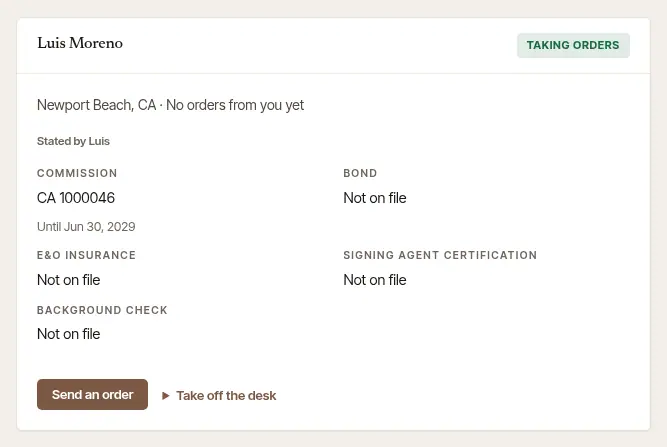
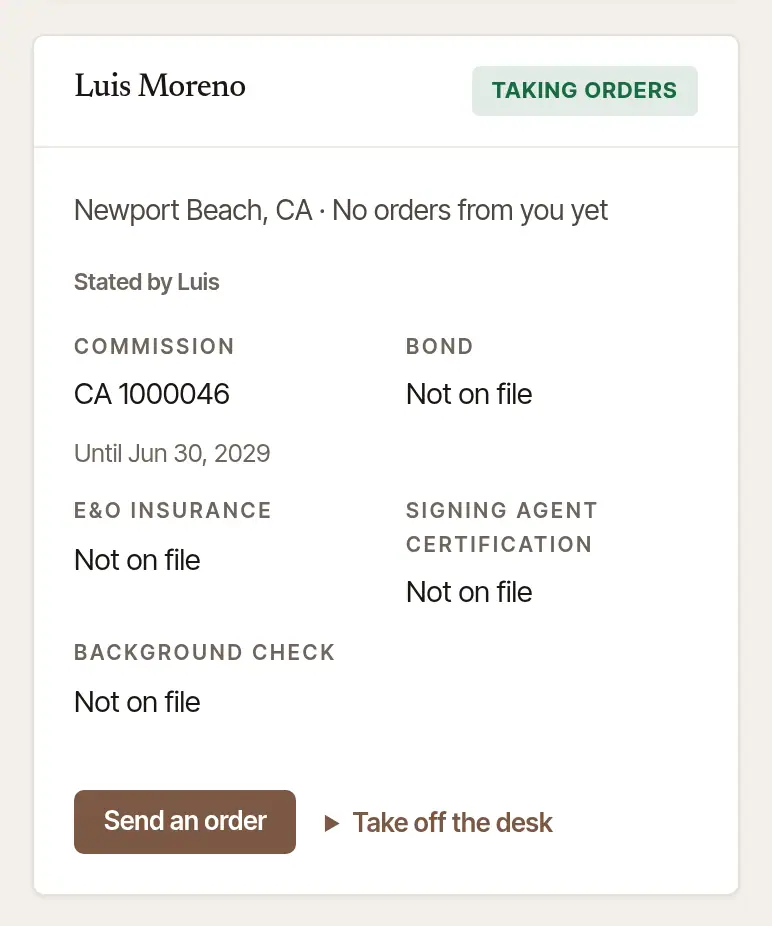
Read their dates. A notary who shares their credentials with you shows:
- Checked by Hand & Seal, when it's there: Commission on their state's list of notaries — their commission was found on the state's own published list, under their name — by its number too, where the list shows numbers — and Until, its last day as the list has it. Hand & Seal can look in eleven states' lists; elsewhere this isn't shown.
- Everything under Stated by their name is what the notary entered — beyond what Checked by says, nobody has checked it:
- Commission — their state and commission number, and until when (for a checked commission, its last day is under Checked by).
- Bond and E&O insurance — the amount, and until when (or No end date on file).
- Signing agent certification and Background check — until when.
Anything they haven't entered says Not on file. A date within 60 days shows how many days are left — Last day on its last — and one that has passed says Expired. A notary who holds more than one commission shows the one that runs longest and, each with its own bond and E&O, each other commission of theirs in a state where an order your desk sent them is accepted or done. An order cancelled since doesn't count, nor does a commission they've let go, more than a week past its last day. An order their business hands to someone else still counts for the notary you sent it to, and not for the one who took it on.
Told when one runs out. Each owner of your desk with a confirmed address is emailed about a date on a notary's card that runs out within 30 days — or ran out in the 30 before — with the notary's name and the date (Credentials to renew): once at most, and one letter a week at most about the same notary. If two of a notary's commissions end on the same day, or two bonds or two E&O policies, you may be told of only one. It covers every notary whose dates show on your Notaries. When you send an order, the form says which of the chosen notary's dates run out before the signing's day — of their commissions, once it has read an address in the state of one on their card, only that one, or, if the order goes under another of theirs, that one. A date is the one the notary gave — a checked commission's, the state list's — and they may have renewed without entering the new one yet, so ask them.
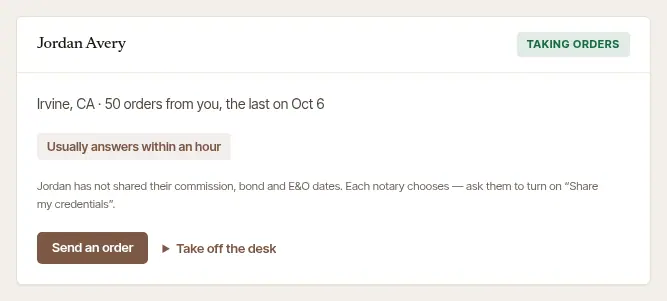
Who sees them. Each notary decides, with Share my credentials in their own settings — and even then, only companies they work with see them: one whose order, sent from its desk, they've accepted; one they gave their order link to; or one whose invitation they took. A company that found them in the directory and has only sent orders they haven't taken sees none of it.
If a notary hasn't shared them with you, their card says so in a line: Credentials: not shared. What that means, under it, says who chooses: each notary, with Share my credentials, and then only with companies whose orders, sent from their desk, they've accepted, or that they gave their order link.
Their W-9
A notary can keep their W-9 on Hand & Seal and share it with the companies whose orders they've taken, so you don't have to ask for one before their first invoice.
Find W-9 on file on their card. It shows only when the notary shares their W-9, and has taken one of your orders themselves — accepted it by their own hand, or done the signing.
Choose View. It opens in a new tab, straight from Hand & Seal, and only for someone on your desk. It isn't kept in your browser, and its address works for nobody else.
Every look is written down: the notary is told each time — on their devices and by email — and sees which company viewed it, and when. Save a copy to your own files the way your company keeps vendor tax forms.
Good to know
A W-9 carries a Social Security or employer number, so it is guarded closely. It is stored encrypted, never shown on a notary's page or in the directory, and a company that is only looking — or whose orders the notary hasn't taken — never sees it. An order accepted for the notary automatically, by their own rules, counts only once the signing is done.
Badges, never a miss
Some cards carry a badge the notary has earned on Hand & Seal — on your desk, and on their line in Find a notary:
| Badge | What it means |
|---|---|
| Reliably on time | Their arrival, as their own phone recorded it, within 10 minutes of the time agreed, at 9 in 10 of at least 10 counted signings in the last six months. |
| Ships by the next morning | Packages marked shipped by noon of the next weekday, 9 in 10 of at least 10 in the last six months. |
| Usually answers within 15 min (or within 5, 10 or 30 min, an hour, or 2 to 4 hours) | How soon they usually answer a request here. |
This is all anyone else ever sees of a notary's record. You never see a late arrival, a count against them or a rate — and a notary without a badge reads exactly like someone new, with nothing said against them. The arrival is the notary's “I’m here”, or the moment their phone saw them park at the address. Signings by video and walk-ins aren't counted at all. A signing isn't counted either way when its time or place changed within three hours of it, when it was booked too close after the one before, or when there's no “I’m here” at the address to go by: none was recorded, or it was recorded more than 800 meters away. One recorded with no location counts as at the address. Saying no to an order never counts against them.
General information, not legal advice
The platform checks a commission only against the state's own list of its notaries, and only in the states whose list it can check. The other dates are what each notary entered, and the W-9 is the notary's own form. What your company must check before using a notary — and how often — is set by your own vendor policy and the rules you work under. This is general information, not legal advice.
Was this helpful?
Still stuck? Contact support — a person reads every message and answers by email.