Question
How does the directory list me — and why can't I find myself?
Who is listed, for which towns, and in what order — commission checked, then the day's turn, with a small lift for badges earned — and the usual reasons a notary isn't there.
People looking for a notary search the directory by their town, ZIP code or county. You're listed there when all of these are true:
- Your page is published — not a draft, and not taken down.
- Your commission hasn't expired. It's listed for the state that commissioned you, through the date it expires: at the first midnight that night anywhere in that state, you leave that state's listings — until you add the renewed one under Commission in Settings → Account.
- Your account is on a trial or a plan.
You're found for places in each state you hold a current commission in, within the miles you said you travel, measured from the middle of your home town. The directory's distances are estimates, and say so.
Search engines are asked to leave a town's page out of their results unless it's a town of 2,500 people or more that at least 3 listed notaries come to, and no other town of its state at least as big, whose page is offered, has nearly the same notaries: four in five or more of those who come to either one come to both.
If you hold more than one state's commission
Add each one in Settings → Account: under Commission, choose the other State, give its number and when it expires, and choose Save.
You're listed in each state you hold a current commission in, by the same miles from the same town. Where your miles reach none of a state's towns of 2,500 people or more, you're left off that state's list and its page, however long its commission runs; a search of a place in it that's within your miles still finds you. In a search of one of your states, your card says what is so of that state's commission and no other — whether it's on that state's list — and its figure is held to that state's limits. Nothing on it says you hold another. With no place searched, your card's “from” is the least our estimates give for a place in a state you travel to; in a state your home isn't in, that's with the travel to its nearest place within your miles. When one commission's last day has passed you leave that state's search, and stay in the other's.
Your page names each state you hold a current commission in, each with its own check and its own date; one whose last day has passed isn't named. If a state's list was looked at and doesn't show a commission, your page gives that one as yours, not yet found on the list. Your fees are shown for the commission that runs longest, with each act only another of your states lists, that a signing there is charged more for, or that it counts by another unit (by the page, say), after them, marked with that state (“Protest · in Maryland”) and at no more than its limit, and your page says that a signing in another of your states is held to that state's limits.
Some states have every notary who is not an attorney say so, in set words, wherever they advertise. Your page, and its request form, carry the words each of your states asks for, each once however many states ask the same, each with the states that require it named before it (“As Maryland requires: …”), and each state's condition under Loan signings. A search of a place or a state carries that state's words when someone listed has to say them, in the languages they list, and the list with no place or state searched carries each listed state's. On Public profile there's an I'm an attorney licensed to practice law in … box for each of your states that has such words: ticking one takes off what your page, its forms and your card say for that state of a notary who is not an attorney, and nothing for any other state.
Your page's request form and your order link book a signing under the commission of the state its address is in: that state's rules and fee limits, on the days that commission covers. A time that commission doesn't cover, a kind of notarization that isn't listed here for its state, or a service that state closes to a notary is refused in words before the request can go.
A signing in a state you hold no commission in goes by the commission that runs longest, as it would if that were your only one: it's refused, unless that commission's own state lets its notaries act there on a condition. Then the request can come to you, under that commission, with that state's sentence on the job for you to read and settle.
The order
Unless someone sorts by Soonest free, Nearest or Lowest estimate, the directory's order is the same for everyone, and it says so on the page:
Commission checked comes first — where Hand & Seal can check your state's list of notaries, and has found your commission on it. It's weighed only among notaries of the same state: where Hand & Seal can't check a state's list, nobody there is checked, and nobody is placed lower for it.
Then the day's turn. Among notaries alike on that, the order changes every day, the same for everyone who searches that day — so someone new is seen as often as someone with hundreds of signings.
A badge earned for keeping signings gives a small lift within that turn — Reliably on time or Ships by the next morning. No badge puts you exactly where anyone new stands: nothing counted ever puts anyone lower.
Nobody can pay to be listed higher.
Your record, and the badges
Companies and clients only ever see badges you've earned — never a late arrival, a count of misses or a rate. There are three:
- Reliably on time — your arrival, as your own phone recorded it, within 10 minutes of the time agreed, at 9 in 10 of at least 10 counted signings in the last six months.
- Ships by the next morning — packages marked shipped by noon of the next weekday, 9 in 10 of at least 10 in the last six months.
- Usually answers within … — how soon you usually answer a request: within 5, 10, 15 or 30 minutes, within an hour, or within 2, 3 or 4 hours, shown only when it's within 4 hours. It's shown, never ranked: a notary at a signing can't answer.
How soon you usually answer is the middle of the times you took to answer the requests and orders that reached you in the last six months, rounded up, once at least 10 are counted from at least 3 different people or companies: each from when it reached you to your business's first answer — a yes, a no, a fee you named instead of a yes, or a message to the person who asked, whichever came first. A no counts only when someone in your business said it: a company keeping its own fee is never your answer. A request with no answer counts as long as it waited: until it closed, was called off or two days had passed, whichever came first — so one left two days counts as two days. One that closed or was called off within 30 minutes of reaching you isn't counted — a last-minute order that lapsed at its start, say.
These aren't counted either: one another notary took first when several were asked at once; an order with an Answer by time, from a company that named backup notaries, that you didn't answer — not answering in time is never held against you; one Say yes for me accepted for you; one never sent; and one that ended because the person at its email address said they didn't send it.
Each day it's worked out from the requests that reached you before that day began, by the clock of the business your page is in, and what had become of them by then: a request that reaches you today, and an answer you give today, count from tomorrow. On your card in Find a notary it's beside your next free time, and the card leaves it out while you're not taking requests; your page and a company's desk show it all the same.
Your record, at the foot of Public profile, is yours alone: what others see, what was counted in the last six months, the recent signings that weren't counted and why, and a tip when one would help.
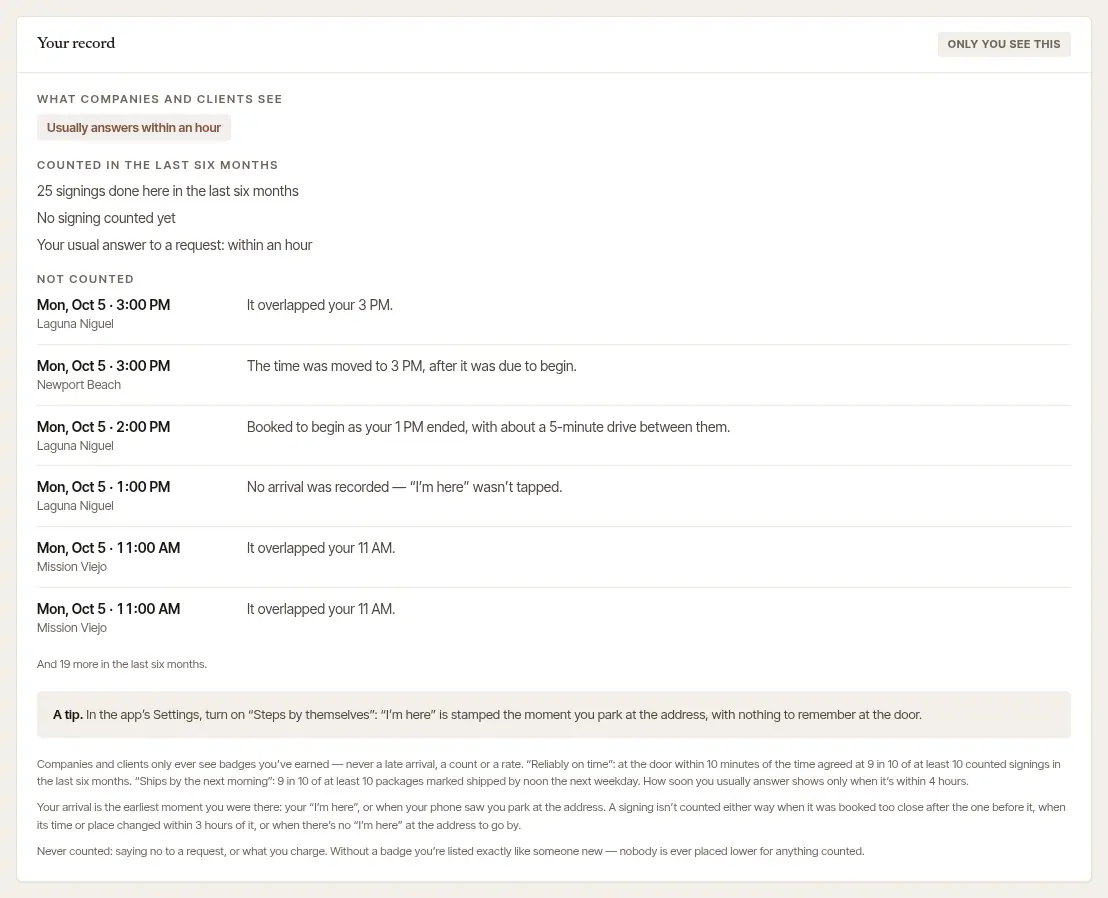
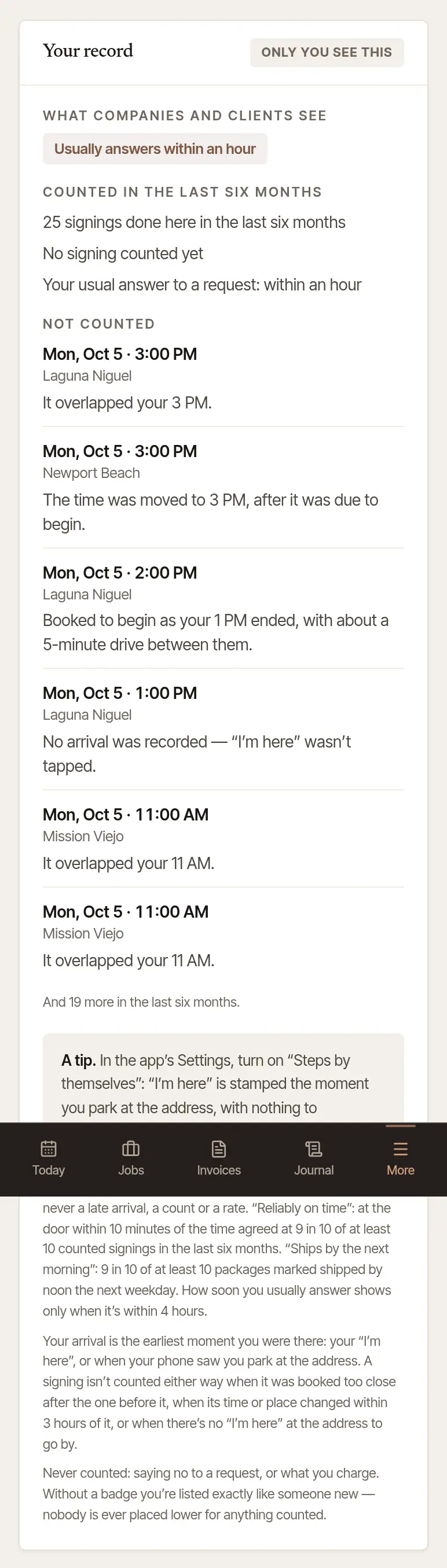
Your arrival is the earliest moment you were there: your I'm here, or when your phone saw you park at the address. Signings by video and walk-ins aren't counted at all. A signing isn't counted either way when it was booked too close after the one before it, when its time or place changed within 3 hours of it, or when there's no I'm here at the address to go by: none was recorded, or it was recorded more than 800 meters away. One recorded with no location counts as at the address. Saying no to a request never counts against you, and what you charge is never counted.
What it brings you
Where your work came from, under Your record, is shown to you alone, as your record is: your signings here that came in over the last 90 days and are still on or done, each counted once by how it came — from orders you forwarded, through your order link or a company's desk, from your page, from Find a notary, or booked by you or your business. A signing your business handed on to you counts as booked by you or your business. A request counts as Find a notary's when it was sent from a search's list, from your page opened from one, or by asking two or three notaries at once.
Not there?
- A draft, or taken down. Publish it on Public profile.
- Your commission has expired, or its renewal isn't in yet. Add it in Settings → Account.
- Your trial ended, or your plan lapsed. Your page and your place in the directory come back the day you subscribe (Settings → Billing).
- The place searched is in a state you hold no commission in, or farther than you travel. Check your Home base and How far you travel (miles) under Your practice in Settings → Account.
- A filter left you out — a language or specialty you haven't ticked on your page, or a day you have no free time.
Not taking requests? You're still listed, with “Not taking requests” on your card, until you tick Take requests from this page again.
Was this helpful?
Still stuck? Contact support — a person reads every message and answers by email.