Guide
Read your state's rules as the app applies them
Settings → State rules — a summary of your state's journal, ID and fee rules as Hand & Seal applies them, the law each comes from, changes coming on a date, and how far they've been checked.
General information, not legal advice
This page explains how Hand & Seal works. Your state’s law, and your commissioning authority, decide what you must do — when in doubt, ask them or a lawyer.
Hand & Seal carries a set of notary rules for every state and D.C., drafted from each state's own law: whether a journal is required and what goes in it, which IDs are accepted, when a thumbprint is asked for, and the most that may be charged for an act. Where we could not establish a rule from the text — a few fee limits, and whether some states allow a travel fee at all — the card says so. The journal form, the fee limits and the phone all read them. Settings → State rules shows you what the app is applying for your state, and where each rule comes from — so you can check it against the law.
Read them
Open Settings → State rules. On the web, Settings is at the foot of the left side (at phone width, under More); State rules is one of the tabs along the top.
Read the summary. The card is headed with your commission's state, and lists the rules that matter day to day — for example, whether your journal must be a bound paper book, when a thumbprint goes in it, the most you may charge for an act, how travel fees work, what happens to your journals when a commission ends, and how a signer's identity may be proved. An act whose fee limit we have not established is named there too.
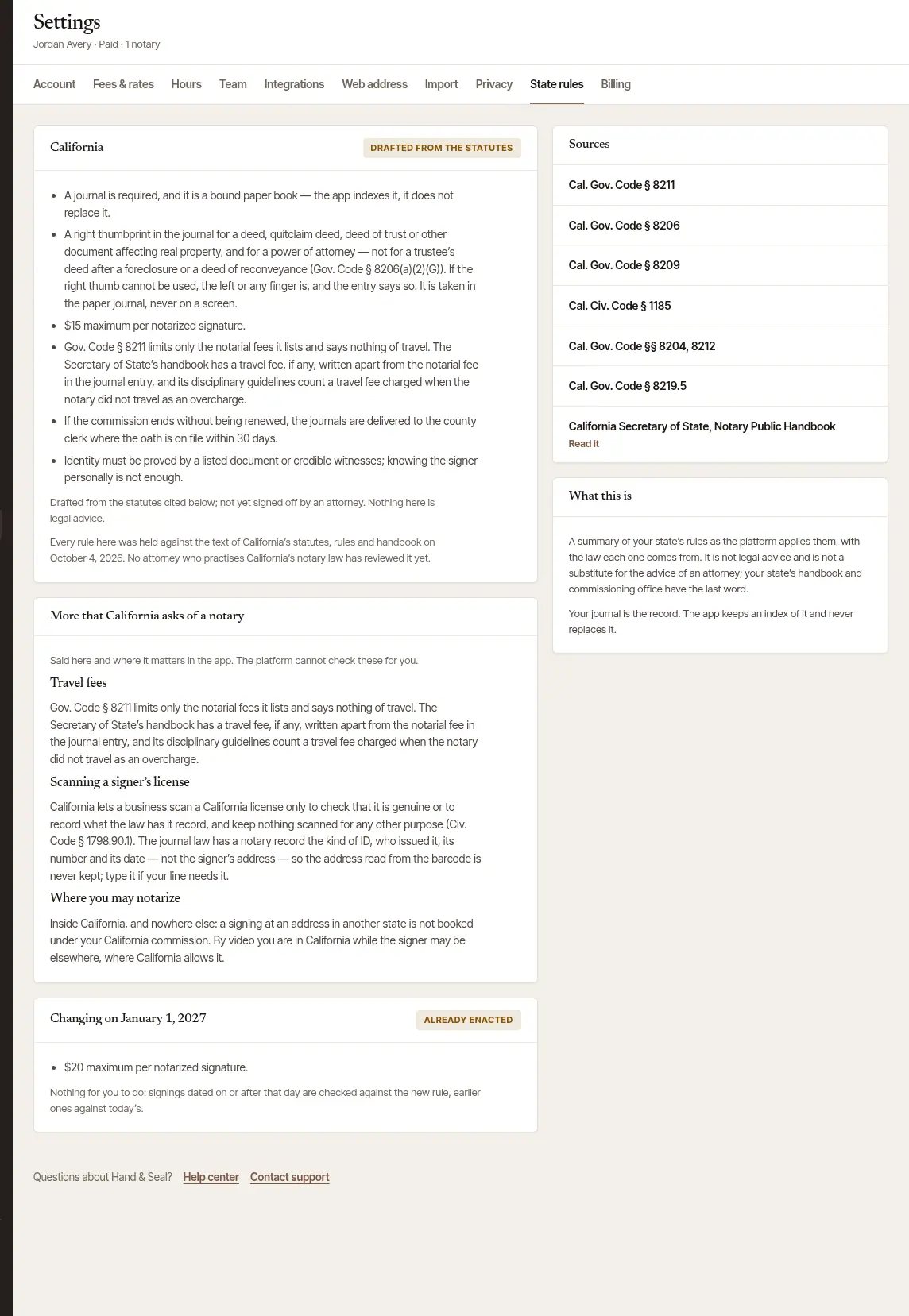

See how far they've been checked. The label beside the state's name says:
- Reviewed — signed off by an attorney who practises your state's notary law, with who and when. No state is marked this way yet.
- Drafted from the statutes — written from the laws listed under Sources and held against their text on the day the card says, and not yet signed off by an attorney. Every state is marked this way today.
- Not yet verified — nothing is enforced for you: you set your own fees, and the journal form offers every field. Follow your state's handbook.
Look at what's changing. When a new law has passed but isn't in force yet, a card says Changing on its date, marked Already enacted, with what changes. There's nothing for you to do: signings dated on or after that day are checked against the new rule, and earlier ones against today's.
Check the source. Sources lists the statutes and the handbook each rule is drawn from; Read it opens one where it's online.
Where the rules show up
- Close-out and journal lines ask for what your state's journal asks for, offer the IDs it accepts, and ask about a thumbprint where it wants one — see Fill in a journal line.
- Fees — an act's fee is held to your state's limit, on the web and on the phone, where your state sets one and we have established it; an act whose limit is not established says so where its fee is set. Where your state limits a travel fee by the mile — or, in Nevada, by the hour — a job's travel is held to that limit too.
- Signings by video are offered only where your state allows them — see Can I do signings by video?
- Each journal line shows the state's rules it was written under, with the date those rules took effect — so a line written before a change is still read by the rules of its day.
No state here yet? The page says No state chosen yet: choose Add your commission, and the rules follow your commission's state.
Something looks wrong?
If a rule here doesn't match your state's handbook, follow the handbook — and write to us, saying which state and which rule, so it can be checked.
General information, not legal advice
This page is a summary of your state's rules as the platform applies them, with the law each one comes from. It is general information, not legal advice. Your state's notary handbook and its commissioning office have the last word, and a lawyer can advise you on your own situation. Your bound paper journal, where your state requires one, remains the legal record.
Was this helpful?
Still stuck? Contact support — a person reads every message and answers by email.