Question
Why doesn't my income match what I've billed?
Your books count money when it's received, not when an invoice goes out — and split each payment into notarial fees and everything else, from the job's own lines.
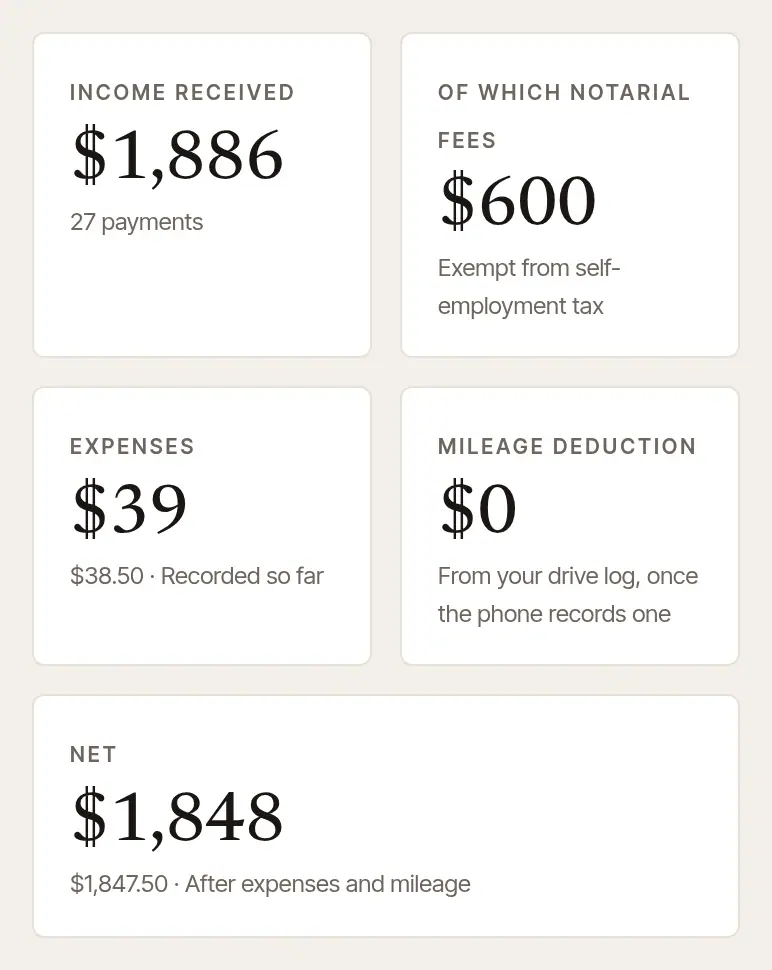
Because your books are kept on a cash basis: income counts on the day a payment is recorded, not the day an invoice is sent. An invoice still waiting to be paid is money owed to you — it's on Invoices (on the phone, Books → Owed to you) — and it reaches the books only once it's paid.

A few more things that make the two figures differ:
- Part-payments count as they arrive; the rest counts when it's paid.
- A payment received in January for December's signing is January's income — the day it was received is the day that counts.
- Refunds come off the year's income, and Income received says how much was refunded.
- A card processor's fee isn't taken off the payment: the full payment is income, and the fee is recorded as an expense of its own, on its Schedule C line.
- A voided invoice, or a fee you waived, was never income.
Of which notarial fees is the part of your income that came from notarial acts, worked out from each job's own lines — acts apart from travel, printing and waiting — never typed or guessed. A part-payment carries its share of the invoice's notarial fees. It matters at tax time: fees for notarial acts carry no self-employment tax. The exemption names only fees for services as a notary public. Hand & Seal counts everything else you charge as ordinary self-employment income.
Nothing is typed twice. Every income line was written by a payment — recorded by you, or by a card payment arriving — and each traces back to its invoice and its job.
Good to know
Tax information, not tax advice. Your books are kept on a cash basis; if your preparer keeps yours another way, give them the year's files from For your accountant on Books.
Was this helpful?
Still stuck? Contact support — a person reads every message and answers by email.